On Sea Island, New Dock Regulations Are Worth Keeping Up With
Jacob Aiken August 20, 2026
Jacob Aiken August 20, 2026
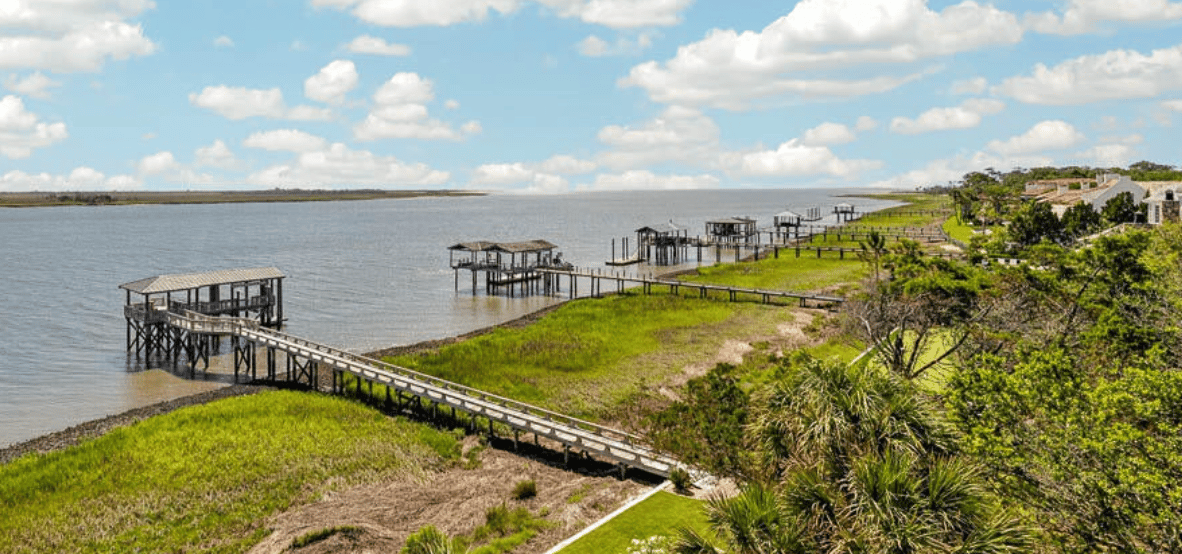
Margaret Sovey has stood at the same bank of windows on Sea Island for three decades. When she and her husband built their marshfront home in 1996, the view south toward Village Creek was open water and grass, the kind of unbroken saltmarsh vista that justifies a premium on this island more than almost anything else. These days, when she looks out from her kitchen table, she has to crane her neck to find any part of that original view still open. Half a dozen dock walkways, each stretching past 700 feet, now cross the marsh in front of her.
Her story is not a cautionary tale about a bad purchase. It is a preview of what every buyer evaluating a marsh-view lot on Sea Island right now should understand before they price that view into an offer: it is not a fixed asset. It is a probability, and the odds are about to shift.
The marsh in front of a Sea Island home is not part of the lot. It is state-owned tidal bottom, held in public trust — and Sea Island may hold a claim to it as well. What you are actually buying is the upland portion of the property.
Because of that, we recommend a Marshland Delineation Study before you buy, so you know exactly where your property ends.
Either way, no homeowner owns the marsh. What a dock conveys is a revocable license from Georgia's Coastal Resources Division, the state agency that permits private docks across all eleven coastal counties. That license lets you build a walkway over public land to reach navigable water. It does not prevent a neighbor from being granted the same thing.
This distinction matters more this year than it has in a long time. Georgia officials have proposed new statewide dock regulations that would let private walkways run wider and farther across the marsh than current practice generally allows, and the state board that governs coastal permitting is scheduled to vote on the change next month (October, 2026). The public comment period closed July 24.
What's Actually Changing
Dimension | Current practice | Proposed rule |
|---|---|---|
Walkway width | Around four feet or less, the standard cited by dock owners pushing for change | Up to six feet |
Walkway length | No firm codified cap; several existing Sea Island docks already exceed 700 feet to reach Village Creek | Up to 1,000 feet, or 1,100 feet with a variance |
Marsh footprint per dock | Not formally quantified under current rules | More than a tenth of an acre |
The push for wider docks has come from owners who say the current standard is too narrow to be usable. One coastal dock owner told state commissioners that his elderly parents could not walk the length of their existing dock and that it was too narrow for a golf cart, and that children and pets had slipped off the walkway into the marsh. That is a real and understandable complaint. It is also the argument for a change that would let a much longer, much wider structure sit in front of the next marsh lot that gets sold.
Research behind the proposal, including work from the University of Georgia's Skidaway Institute of Oceanography, has found meaningfully sparser marsh vegetation under existing docks compared to open marsh nearby. Conservation groups tracking the rulemaking have argued the wider standard would let a small number of private owners reshape a public resource, and one advocate flagged that the 0.1-acre footprint figure in the draft rule exceeds the legal definition of a minor marsh alteration written into Georgia's own Coastal Marshlands Protection Act, a conflict regulators have not yet resolved.
Even a buyer who assumes their marshfront neighbor's existing dock is grandfathered at its current size should look closer at the proposed rule's language. Under the draft regulations, a dock the state deems unserviceable cannot simply be maintained. It can be reconstructed or modified, which opens a door to rebuilding an older, narrower dock to the new standard rather than the old one. One conservation advocate following the rulemaking has questioned how loosely the state might interpret "unserviceable," pointing out that an owner who simply wants a golf cart to fit could argue the current dock does not serve its purpose.
For a Sea Island buyer, the practical takeaway is this: a narrow, decades-old dock two lots down is not necessarily a permanent constraint on your view. Depending on how the state applies the new standard, it may be a starting point for something considerably larger.
The instinct here is to pull the state's dock permit records before closing and see what every neighboring parcel is entitled to build. That instinct is sound. The problem is that Georgia's own dock permit database, the tool a buyer or their attorney would actually check, is not a reliable record of what exists or what is allowed.
The agency's records are patchy for anything permitted before 2013, the year it modernized its recordkeeping system. Older permits generally did not carry over unless an owner later requested a modification. Even for more recent entries, the database does not reflect what actually happened on the ground: docks lost to storms and never rebuilt, permits issued but never used, or homes that changed hands enough times to accumulate several permits in the system, one for each past owner. About twelve percent of the records in the database do not even list a maximum allowed dock length. The agency itself has cautioned that because of how records were historically kept, land use and marsh impacts from docks are close to impossible to quantify from the database alone.
In practice, this means a title search or a quick look at the state's online permit map will not tell a Sea Island buyer whether the empty marsh view next door is protected by an old, narrow permit or open to a much larger structure once the new rule takes effect. Getting a real answer means calling the regional Coastal Permit Coordinator directly and asking about the specific parcel, not trusting the map.
None of this is a reason to avoid marshfront property on Sea Island. It is a reason to treat the view differently than the price sheet does. A marsh-view premium prices in the assumption that today's open water and grass will still be open water and grass in five years. That assumption now rests on a regulatory decision that has not been made yet, applied through a permitting system the state itself describes as an unreliable historical record.
Before making an offer on a marsh-facing lot, it is worth asking specifically which adjoining and nearby parcels already hold dock permits, how long those permits have been active, and whether the current owner has any documentation beyond what the state database shows. It is also worth asking your closing attorney to contact the Coastal Resources Division directly rather than relying solely on the public database, since the agency itself has flagged the gaps in that system.
The same rule that could bring a bigger dock to your neighbor's parcel also applies to yours, so a buyer who wants their own longer or wider dock down the road has real reason to watch how this vote lands too.
Does this rule apply only to Sea Island? No. The proposed regulations would apply across all eleven of Georgia's coastal counties. Sea Island's layout, with private homes backing directly onto relatively narrow tidal creeks like Village Creek, simply means the visual impact of a handful of larger docks lands on fewer households, which makes the change more noticeable here than in areas with wider open water.
Is the rule guaranteed to pass on August 25? The Georgia DNR Board postponed the vote at its August 25, 2026 meeting to its October meeting.
If I already own marsh frontage on Sea Island, does this cut against me too? Not necessarily. The same standard that could allow a neighbor to build wider and longer would apply to your own dock application as well, so an existing owner considering a future dock project has reason to follow this rulemaking closely rather than assume it only affects other people's views.
Marsh-view real estate on Sea Island has always carried a premium tied to something you cannot fully control: what happens on the water in front of your house. That has never been more literally true than it is with a state vote ten days out. If you are weighing a marsh lot here and want a second set of eyes on what the permit history around a specific parcel actually shows, that is exactly the kind of groundwork Page Aiken does before a client ever writes an offer. Start the conversation.
Stay up to date on the latest real estate trends.


Local
Not All Marshfront Is Created Equal

A data-driven approach paired with international experience ensures every client benefits from a deeper understanding of market movement and opportunity.